Behind the Headline
Updates, excerpts and exclusive extra material related to my story in The Economist.

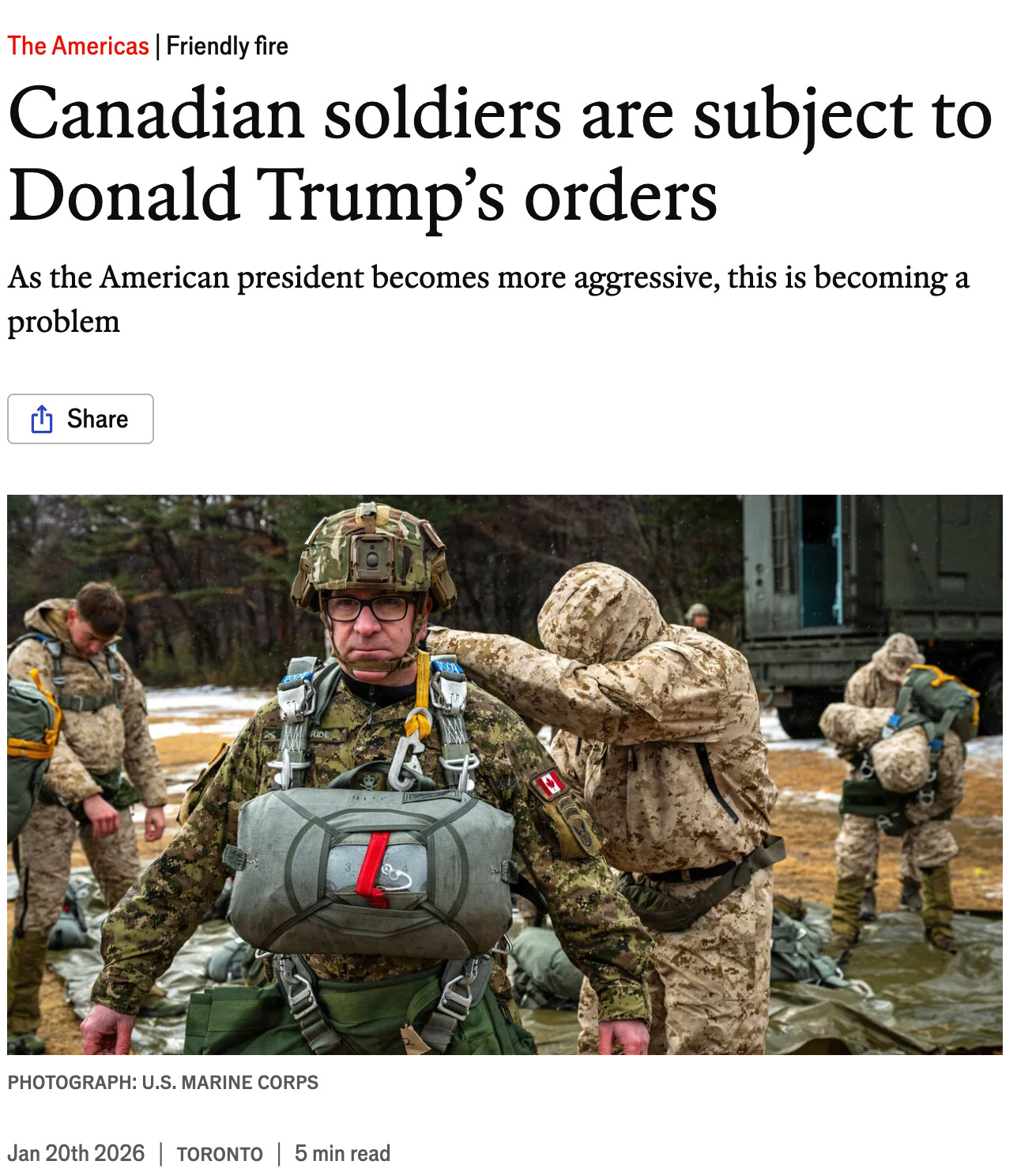
Canadians embedded inside the American military during US President Donald Trump’s reign must walk a razor wire - following orders from a hostile Washington administration while still adhering to Canadian military laws, protocol and expected conduct.
“We are so intertwined with the Americans, as we should be…we’re multi-generational allies,” Colonel-Maitre Michel Drapeau, a CAF veteran, military lawyer and legal expert told me on Monday. “In many respects, they hold our security in their hands - it’s a huge problem.”
Aside from the list of high-ranking CAF members I wrote about in The Economist (which was not exhaustive), Canadians on exchange can also be attaché, support services, exchange officers, liaison officers, students and non-commissioned members of the CAF.
An archived Canadian government web page last modified in 2016 states “at any given time there are more than 700 CAF members serving in the United States.”
That’s significant - and doesn’t account for our agencies such as CSIS, CSE, RCMP and CBSA - who frequent Quantico for training.
So, are there exchanges with 3-letter agencies south of the border? We send teams and specialists from Canadian agencies on secondment to our European and Commonwealth allies - stands to reason our (literal) closest ally would be included.
(I’ll be looking into this as well)
Questions answered?
After The Economist story was published Tuesday, my phone rang at 8:00 p.m. - I missed it.
A brief back and forth over text ensued and I found myself speaking to senior comms from The Minister of Defence - professional, courteous and apologetic that answers I had requested from them had not materialized prior to publication.
It took 8 days for a reply to questions of particular sensitivity.
Right up until the story went online, I was urging the DND to say something, anything, regarding the information I had found…if Canadians are not involved in the extremely risky (legally, morally, reputationally, operationally) actions the U.S. military has been carrying out, if they have been “caveated” by their superiors - the public deserves to know.
I posted their first response regarding Brig.-Gen. McBride’s potential involvement in whatever the 11th Airborne may be tasked with:
“Members of the CAF on exchange with foreign militaries via the Military Personnel Exchange Program (MPEP) require a National Authority to Deploy (NAD) which is based on the recommendation of the Chief of the Defence Staff and requires approval by the Minister of National Defence (MND). There are currently no active-duty members involved in operations in Minnesota, nor would they be allowed to be without approval by the Government of Canada. At this time, no such a request has been made.”
What’s not addressed in their reply - is whether McBride or other Canadians would be involved in the planning or execution of questionable U.S. military operations with the units they are on exchange with.
By all accounts McBride is an exceptional leader and soldier, and I am sure to some, the answer would be an obvious “of course a Canadian is not going to deploy on an operation that is so morally, legally and ethically questionable!”
But let’s not forget that while then-Prime Minister Jean Chretien refused to officially support the invasion of Iraq, we were involved.
Verbatim from The Canadian Encyclopedia:
Although President George W. Bush and other Americans pressured Canada to support the war, at no time did US defence officials ask Canada to provide troops. Yet Canada did support the invasion indirectly. In fact, some sources claim that Canada’s military support exceeded that of most coalition members.
Canadian ships were already in the region to support the invasion of Afghanistan. Although the Canadian navy was instructed not to assist American operations against Iraq, it was often difficult to distinguish whether an interdiction mission undertaken by RCN warships, including their embarked RCAF helicopters and crews, was in support of the war in Iraq or Afghanistan. (Interdiction missions aim to destroy, delay or disrupt enemy forces or supplies before they reach a combat zone.) No Canadian fighter aircraft were involved, but Canadian aircrew flew on surveillance missions that directed US attack aircraft over Iraq. Moreover, approximately 100 Canadian exchange officers assigned to American, British and Australian forces were allowed to remain with their units. This included Brigadier-General Walt Natynczyk (later general and chief of the defence staff), who helped plan the invasion of Iraq.
My other questions to the DND regarded tips I had received from active American military sources and OSINT data.
Flight tracking data showed that the USAF have used C-17 Globemaster III planes to fly deportees accused of being gang members - with no evidence, due process or forewarning - to CECOT in El Salvador.
A November Human Rights Watch report called the Trump administration “complicit in torture, and enforced disappearances” stating those deported in March and April of 2025 faced systemic abuse, torture and sexual violence at the facility.
I knew of at least one RCAF pilot on exchange with the USAF during this time period who specifically flew this type of plane.
In this video posted by President Nayib Bukele on March 31, we can see the type of plane in question:

However, the plane in the video was from a different USAF division than the one the RCAF pilot was assigned to - but I asked anyways:
Have any Canadian Armed Forces personnel on exchange been involved in the logistics of flying detainees to CECOT in El Salvador, as crew, pilot, or other supporting or planning roles?
This morning I received this answer from the DND:
“With regards to recent U.S.’s actions related to Venezuela and the Terrorism Confinement Centre in El Salvador (known as CECOT), they are unilateral. The Department of National Defence and the CAF were not involved with these actions.”
Okay, interesting and a relief.
I asked about the multinational crews aboard E-3G Sentry’s - Airborne Warning and Control System aircraft (AWACS) which function as mobile command centres - like the one seen over Ottawa in September which had a Canadian pilot on board.
Two of those planes Steffan tracked were deployed to MacDill Air Force base in Florida in September to be used in Operation Southern Spear.
I also asked about Canadians working at the Joint InterAgency Task Force South, an intelligence hub in Florida, Op. Caribbe and Op. Foundation (which puts some Canadians inside U.S. Central Command, also in Florida) our coast guard working with the USCG and myriad ways Canadians were under the umbrella of SOUTHCOM - because the potential overlap between us and Op. Southern Spear was beginning to look a little uncomfortable.
So I sent very pointed, very detailed questions - including: “has intelligence gathered, shared and analyzed by Canadian personnel or any other support given under US SOUTHCOM” been used by the US in airstrikes on alleged “narco terrorists” or by the American military in their actions in Venezuela? etc.
This is what the DND replied this morning:
“The CAF have provided support to Operation CARIBBE since 2006, a contribution to U.S. Enhanced Counternarcotics Operations under Joint Interagency Task Force South (JIATF-South). The CAF remains committed to working with our multinational partners to disrupt illicit drug trafficking, in support of law enforcement efforts and in line with applicable Canadian and international law.
As of this moment, there are no planned changes to Canada’s Operation CARIBBE engagements. Operation CARIBBE remains a separate and distinct operation from other US operations in the region.”
The Economist story was updated again, regarding the Globemaster allegations - but the second portion of the DND answer elicited more ??? than anything else.
I really, sincerely hope that the answer to all my questions regarding Canadians being involved in Trump 2.0’s orders to the American military is a big, fat no.
I recognize how sensitive this story is, how our long history with the Americans means we can’t just press ‘pause’ on decades of integration, allyship and brotherhood - but Canadians deserve to know the truth.
—- That’s The State of Things —